
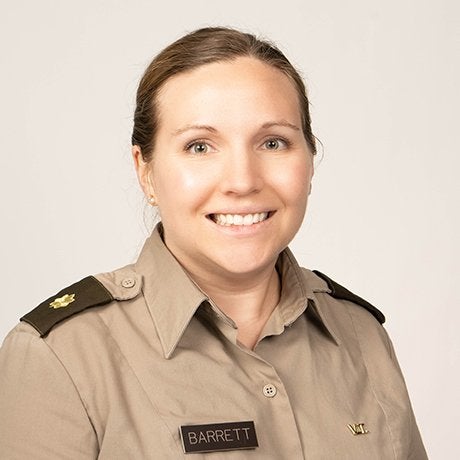
Emma Barrett
- Chair, Chemistry and Biochemistry
- Assistant Professor of Chemistry
About
Dr. Emma Barrett earned her Bachelor of Science in chemistry from Emmanuel College (Boston) and her doctorate in chemistry from the University of Vermont (Burlington, Vermont). After completing a postdoctoral fellowship at Boston College, she joined Norwich University’s faculty in 2021 as an assistant professor. Barrett teaches organic chemistry lecture and lab, as well as senior synthesis and research courses.
Barrett’s research lies at the intersection of chemistry and biology, aiming to synthesize chemical tools that can be used to solve biological problems. She is interested in peptides with unique biological activities, specifically antioxidant peptides; the incorporation of non-natural amino acids into peptides; and the synthesis of novel amino acids. In addition, Barrett is always open to exploring new project ideas generated by students. She has served as a mentor for numerous student-led research projects, including the synthesis of biodiesel from algae, water quality testing in local rivers, and the binding of fungal biomolecules to heavy metals.
Barrett is dedicated to conducting interdisciplinary research at Norwich University and has been awarded multiple grants from the Vermont Biomedical Research Network (VBRN) to support her work. She was awarded a $10,000 startup grant in 2021 and a $25,000 pilot grant in 2023 from VBRN. Barrett is a member of the VBRN bioorganic thematic group, where she collaborates with other faculty members throughout Vermont.
Barrett is an active member of the American Chemical Society (ACS) and is an advisor for the student ACS club at Norwich. Her research students have presented their findings at national ACS conferences and at other conferences, including the National Conference on Undergraduate Research (NCUR). Barrett is also dedicated to science outreach and serves as a volunteer organizer of the Vermont STEM Fair.
Education
Ph.D. Chemistry, University of Vermont
B.S. Chemistry, Emmanuel College
Research Interests and Expertise
With her research, Barrett aims to develop and use chemical tools to solve biological problems. She is particularly interested in peptides equipped with non-natural amino acids that have unique biological activities. Other research interests include designing conformational switch peptides, incorporating redox-active amino acids cysteine and selenocysteine (and their derivatives) into peptides, and designing peptide therapeutics with enhanced pharmacological properties.
Courses Taught
CH225 Organic Chemistry 1
CH226 Organic Chemistry 2
CH421 / CH 425 Chemical Synthesis & Examination I / Research
Publications
Ste.Marie, E.J., & Hondal, R.J.. (2022). Application of alpha-methyl selenocysteine as a tool for the study of selenoproteins. Methods in Enzymology, 662, 297-329.
Ste. Marie, E.J., Wehrle, R.J., Haupt, D.J., Wood, N., Van Der Vliet, A., Previs, M.J., Masterson, D.S., & Hondal, R.J.. (2020). Can selenoenzymes resist electrophilic modification? Evidence from thioredoxin reductase and a mutant containing alpha-methyl selenocysteine. Biochem., 59(36), 3300–3315.
Ste. Marie, E.J., & Hondal, R.J. (2020) 2,2'-Dipyridyl diselenide: A chemoselective tool for cysteine
deprotection and disulfide bond formation. J. Pept. Sci., 26(3), e3236.
In the News
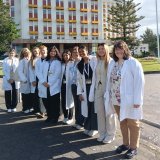
Students Gain Rare Clinical Exposure Through Global Healthcare Maymester in Coimbra, Portugal
Students gain firsthand clinical experience in Portugal through Norwich University’s Global Healthcare Immersions Maymester, shadowing physicians across multiple specialties while exploring global approaches to healthcare.

The Value of Endowed Scholarships
During the Board of Trustees and Scholarship dinner, a cadet shares his journey to Norwich and the role of scholarships that have supported him, allowing him to pursue an advanced degree and a career in forensics and the National Guard.
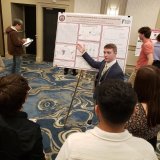
Students Shine at VBRN Career Day
Norwich students present research and earn awards at the Vermont Biomedical Research Network Career Day.