Upper Parade Ground Flag flying above Jackman Hall

Leadership at Norwich

Lead Here. Lead Anywhere.

One Campus. Many Pathways. One Leadership Standard.

At Norwich University, leadership is not a title, it’s a way of life. On The Hill, every student, both in the Corps of Cadets and civilian student body, learns to lead with integrity, courage, and a commitment to service.

Leadership is in Our Mission

Norwich University was founded to educate citizen-soldiers, leaders prepared to serve and strengthen their communities, workplace, and nation. Today, that purpose shapes every student’s experience on The Hill, building the leadership mindset and resilience that has defined Norwich graduates for over 200 years. 

Leadership at Norwich is:

  • Intentional – Built into our curriculum, student life, and traditions.
  • Experiential – Learned by doing, not just be reading about leadership.
  • Values-Driven – Grounded in honor, integrity, respect, and service.

Whether a member of Corps of Cadets or civilian, on the field or in the studio, preparing for a future military career or the private sector, you will discover your capacity to influence, inspire, and lead.
 

One Campus. Many Pathways.

What are the Pillars of the Norwich Leadership Development System?

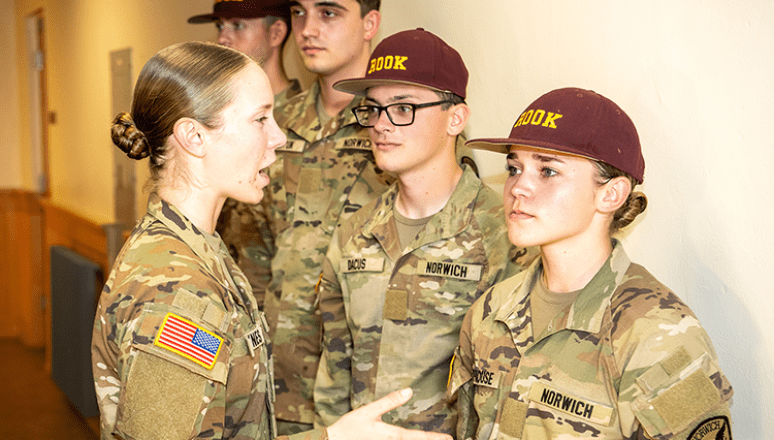
Rooks in the barracks being instructed by cadre.

Leadership

Norwich develops educated leaders known for their courage, determination, and positive impact on our country and world. Our graduates are marked by the belief that we succeed through our team's success and that the hard-right path is preferred over the easy wrong path. Professionals who build enduring bonds of respect and trust with their charges, colleagues, and superiors often secure that success. Norwich leaders are identified by the confluence of their knowledge and values, combined with the confidence to bring them both to life through words and deeds.

emergency services

Citizenship

Since our founding, Norwich has provided the Nation with graduates of character and vigor capable of growing, improving, and defending the institutions of America and the philosophies that breathe them to life.  This capability has been born through the embrace of respectful debate, a thirst for knowledge, and a willingness to act when others hesitate.  Our graduates have made their marks in all fields of citizenship and have been admired for their willingness to explore the unknown territory of human possibility. 

military at norwich graduation

Service

Our graduates’ leadership abilities and deep understanding of the requirements of citizenship have earned Norwich a reputation for service – to our ideals, our goals, and the organizations and professions that reflect both.  The world has come to recognize that our graduates exemplify the virtues of self-discipline and honesty that build the trust required for organizations to do important things and improve the human condition.  The value we place on housing these traits in a healthy body with a sound mind arms our graduates with the strength to thrive under adversity and the resilience to persevere through challenges and setbacks.  Our “I Will Try” motto encapsulates our willingness to affect change through service.

Leadership Learning for Cadets and Civilians

Leadership development is intentionally built into the Norwich experience for all students, empowering both Cadets and civilians to lead with purpose.

Cadets in white uniforms stand in a row, holding colorful flags and rifles during an outdoor ceremony.

Corps of Cadets

Members of the Corps advance through a four-year progressive training model with a structured system of responsibility – from learning to follow as a Rook to leading companies and battalions as seniors.

Norwich University Justice Studies student crime scene training

Civilian Students

Extensive leadership opportunities come through student government, residence life positions, peer mentoring, clubs, and community service.

Corps of Cadets and Civilian Students

All Students

Norwich’s mission shapes every student’s experience and shared leadership journey. Cadets and civilian students learn side by side in an environment that rewards initiative, integrity, and teamwork. No matter your major or role on campus, you will find opportunities to lead.

A Norwich University hallway features bold crimson and gold wall graphics. On the left, the NU logo is paired with the motivational phrase “Relentlessly pursue all of your goals” over a faint image of a helicopter. To the right, another NU logo accompanies the school’s motto, “I Will Try,” mounted on a curved sign.

I Will Try

This simple yet defining three-word motto captures Norwich’s leadership philosophy. You will face challenges, learn from setbacks, and continually improving while you keep moving forward.

Leadership in the Classroom

Norwich integrates leadership principles across disciplines – from business and criminal justice to cybersecurity, nursing, engineering, and beyond. Hands-on, applied learning is central to the Norwich experience. Students lead fieldwork teams, manage real clients in design studios, coordinate laboratory assignments, and collaborate with their pees on simulations and capstone projects. These experiences teach students how to delegate, plan, communicate, and adapt – skills essential for leadership in any field.

Academic life at Norwich is intentionally rigorous. Students are pushed to articulate their thinking, defend their ideas, collaborate under pressure, and approach problems from multiple perspectives. These academic challenges mirror the future demands of leadership. Regardless of major, students experience an environment where expectations are high and support is strong, creating the ideal conditions for leadership growth.


Three students presenting their project in the AI Institute at Norwich.


The Corps: A Living Leadership Laboratory

For cadets, every day on The Hill is leadership training in action. The Corps of Cadets uses a 4-year progressive model of leadership training:

Rooks:

Learn discipline, followership, and teamwork.

Upperclass Cadets:

Take on roles leading squads, platoons, and companies.

Senior Cadets:

Plan training, mentor younger cadets, manage complex operations, and model the standards of the Corps.

Cadet leaders are mentored by professional staff, ROTC cadre, and alumni, turning daily routines into lessons in accountability, resilience, and ethical decision-making.

Learn The Details of the Four Year Corps Progressive Leadership Experience below.

Leadership in the Civilian Student Experience

Civilian students experience the same leadership expectations in different settings. They lead by:

Administrative Leadership

Serving as Resident Assistants, orientation leaders, and peer mentors.

Organizational Leadership

Holding office in the Student Government Association and student organizations.

Campus Leadership

Coordinating events, service projects, and club activities. 

In classrooms, labs, studios, and rehearsal spaces, civilian students develop the confidence to present, collaborate, and guide teams. The result is a diverse community of leaders united by shared values. 

ROTC: Developing the Next Generation of Officers

Leadership on the Field, in the Community, and Around the World

Leadership takes root at Norwich when students commit to something greater than themselves and work together to make it happen.

Norwich men and women swim and dive teams

Athletics

- Team captains and student-athletes learn to model standards, build culture, and create grit.

- Coaches mentor students in accountability, resilience, and selfless teamwork.

Mechanical Engineering Students Visit Gillette Stadium in Boston and Applied Research Associates in Randolph, VT

Clubs & Organizations

- Students lead academic societies, special interest clubs, and professional organizations.

- They coordinate events, manage budgets, and recruit and motivate fellow members.

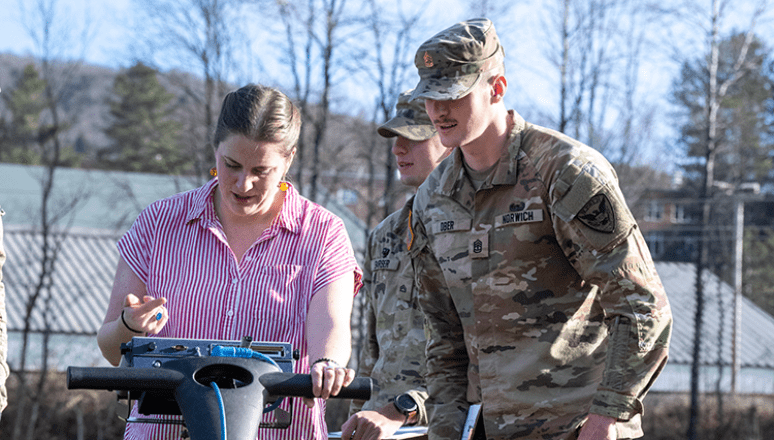
Faculty and students in Geology class reviewing data readings outdoors using high-tech equipment.

Service & Experiential Learning

- Students participate in community outreach, service-learning courses, and projects that connect Norwich to Central Vermont and beyond.

- Leadership lessons are reinforced through real-world impact while supporting veterans, youth programs, wide-ranging community service projects, and more.

Norwich civil engineering students hands on learning outdoors with professor

Guided by Mentors. Grounded in Values.

Leadership development at Norwich is reinforced by a dedicated community of:
—Faculty who integrate leadership and ethics into their teaching. 
—ROTC cadre and Corps leadership who coach and evaluate growth. 
—Coaches and staff who model professionalism and high standards. 
—Alumni who return to campus, speak in classes, and provide networking and career advice.

Four Year Corps Progressive Leadership Experience

  1. Understand and Lead Yourself

    A cadet's Norwich journey begins with Rook Training. This rigorous first semester experience takes students from different backgrounds, develops the basics of self-discipline, begins their exploration of who they want to become, turns them into cadets, and forms them into cohesive units. During the second semester, they will learn to lead themselves with less direct oversight, relying on the self-discipline developed during the Rook experience. This foundation allows them to become an integral part of the Corps and connects them through shared experiences with their fellow cadets and our alumni. The course of the year provides opportunities for the first-year cadets to understand and lead themselves, setting the building blocks of good leadership they will practice in subsequent years. This year includes two semesters of ROTC to complement the Corps of Cadets experience. 

  1. Lead Others

    The second-year experiences build on the foundational skills developed in the first year and focus cadets on leading and developing others. This year, cadets can be promoted to the rank of corporal and learn to be a bridge from the leader to the led. They witness first-hand the leadership and decision-making of their junior and senior leaders. They can use this experience to prepare themselves for the opportunities of their final years at Norwich. While the second-year cadets are challenged to lead others, they continue to grow personally through study, goal setting, and self-assessment, emphasizing development as a servant leader who helps individuals and units achieve their goals. Cadets also participate in two semesters of ROTC academic courses during their second year.

  1. Lead Small Groups

    The third-year experiences allow cadets to apply their leadership knowledge and skills by leading small unit teams as cadet non-commissioned officers. In these roles, the cadets continue their development by leading small units to achieve individual and group tasks and feel the significance of being responsible for the actions of their units and subordinates. Inherent in these tasks, third-year cadets grow to understand their roles as mentors, developmental counselors, and training managers and become more confident in their communication skills and coordination abilities. Their journey takes on the challenges of further developing their physical health, mental resilience, and character refinement. Throughout this year, they are observed and mentored by the Commandant's Professional Staff and senior cadet leaders who provide guidance and evaluate their growth as leaders.

  1. Lead Organizations

    In their final year, cadets lead all aspects of the Corps of Cadets, setting the organizational climate and culture. In both command and staff positions, they create the goals they would like their units to achieve, develop and implement plans to achieve those goals, supervise progress, and evaluate performance. During this experience, they practice and hone the leadership skills and character traits that will enable their success as a graduate. Throughout the year, they draw on the advice and guidance of the Commandant's Professional Staff.