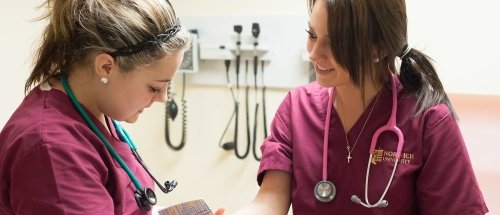
Norwich Students Training in Nursing Lab

Health Science

Where patient care begins.

Every clinical decision starts with understanding the science behind it. Health Science at Norwich opens doors into medicine, physical therapy, occupational therapy, public health, and beyond.

Key Information:


The Field

Employment in health care is projected to grow nearly 20 percent over the next decade, adding more than 2.4 million new jobs. The growth is driving demand for practitioners who can think critically, apply evidence to real populations, and lead inside complex systems.

What is Health Science?

Health Science is the study of how the human body achieves and maintains health. It draws on biology, chemistry, epidemiology, and evidence-based research to understand how health works at the individual and population level.

After graduation, students continue to graduate programs in physical therapy, occupational therapy, physician assistant studies, and medicine, as well as careers in public health, health promotion, and clinical research.

Why Health Science?

You want to provide patient care — and understand the science well enough to make the call yourself, not just follow a protocol.

Some students arrive knowing exactly where they’re headed — PT school, medical school, occupational therapy. Others know they want to work in healthcare and are still finding their direction. Health Science at Norwich is built for both.

More frequently asked questions

What can I do with a Health Science degree?

Many graduates go on to graduate programs in physical therapy, occupational therapy, physician assistant studies, or medicine. Others enter careers in public health, health promotion, and clinical research. The program’s flexible elective structure lets you tailor your coursework toward the path you’re working toward.

How is Health Science different from Exercise Science?

Exercise Science focuses on performance — how the body trains, adapts, and recovers under physical demand. Health Science takes a broader view, building the research literacy and scientific foundation for graduate programs in medicine, physical therapy, occupational therapy, and public health. The two programs share a first year and a faculty.

Do I need to know which graduate program I want before I start?

The Pre-Professional pathway is designed with flexibility — the core gives you the scientific foundation every graduate program expects, and electives let you tailor toward PT, OT, PA, or medicine as your direction becomes clearer. Most students find their path during the program, not before it.
Your Health Science experience

Program breakdown by year

Pre-health professions concentration
Prepares students for graduate or professional study in physical therapy, occupational therapy, physician assistant programs, medicine, and related fields. Core health science courses provide the foundation, with flexibility to tailor coursework toward the specific requirements of the programs students are applying to.

Year 1 — Find your Direction
You start alongside Exercise Science students, building the scientific foundation that everything else runs on. Biology, the principles of health and wellness, emergency care, and an introduction to the health professions. Foundation and discovery — understanding the field well enough to know where you want to go inside it.

Year 2 — The Human System
Human Anatomy and Physiology across two semesters. General Chemistry. Health Science Research Methods. Foods and Nutrition. Clinical Anatomy. Epidemiology. Lifelong Motor Development. By year's end, you understand how the body works at a systems level and how to read the research that drives decisions in the field.

Year 3 — From Science to Care
Health Promotion. Medical Ethics. A physical science and a physiological science course, from options like Kinesiology and Physiology of Exercise. The curriculum shifts toward application — taking what you know about the body and the evidence, and studying how this shows up in practice.

Year 4 — Capstone Year
The capstone year. Students complete an internship and capstone, applying everything they've built toward the graduate programs they're entering. Students develop an original research project, review the existing literature, and present findings. By graduation, you have not only studied the field, but also worked inside of it.


Career outcomes

Health Science opens toward both graduate study and direct-entry health careers. Here's where it can take you.

Public health professional

Connect people to health resources, education, and preventive care, working with community organizations, hospitals, or government health agencies. Norwich's epidemiology and health promotion courses feed directly into community health and outreach.

Public health careers

Clinical research coordinator

Design and manage research studies in hospital and university settings. Paid research internships through the Vermont Biomedical Research Network (VBRN) give Norwich students hands-on experience in this field before they graduate.

Clinical research coordinator careers

Health educator

Design and deliver health programs for hospitals, nonprofits, and government agencies. Direct entry-level path — no graduate degree required.

Health educator careers

Physical therapist

Evaluate and treat patients recovering from injury, illness, or surgery, working in hospitals, private clinics, schools, and fitness centers. The pre-health professions concentration prepares you for admission to a Doctor of Physical Therapy program — meeting the coursework requirements PT schools expect.

Physical therapist careers

Occupational therapist

Help patients develop, recover, and maintain skills needed for daily life and work. Coursework in the pre-health professions concentration meets what most occupational therapy graduate programs require for admission.

Occupational therapist careers

Physician assistant

Provide diagnostic and therapeutic services under physician supervision.
The pre-health professions concentration builds the coursework foundation that physician assistant programs look for at admission. Physician assistant is the fastest-growing career in health care, with 20% projected employment growth from 2024-2034.

Physician assistant careers

Explore more career paths

The Center for Career Readiness can help you explore options, find internships, and plan your next steps.

Center for Career Readiness

Our Faculty

Program Requirements

To view additional program details and degree plans, visit the Norwich University Course Catalog.

The Education Teacher Licensure Program — available in secondary and elementary tracks — is accepted for teaching licenses in Vermont and all states except New York, New Mexico, and South Dakota.

The Physical Education Teacher Licensure Program — available in secondary and elementary tracks — is accepted for teaching licenses in Vermont and several other New England and Middle Atlantic states where the State of Vermont has interstate licensure agreements.

The Athletic Training Program is accredited by the Commission on Accreditation of Athletic Training Education (CAATE).

This is where the work begins.

The science, the preparation, the career in patient care.
Ready to learn more? Explore related programs, connect with an admissions counselor, or schedule a visit to see the Health and Human Performance facilities in person.

Next Steps: The Admissions Process

  1. Here To Help

    We're here to help you along the way.

    We are thrilled that you are considering Norwich and have a team dedicated to help you through every step. College is challenging and fun, applying should be as simple as possible. Reach out to your admissions counselor whenever you have questions or need help!

  1. Apply Now

    Complete an application online using either the Norwich app or the Common app.

    Norwich Application

    Start your application using our in-house form.

    Norwich Application

    Common App

    Already have a Common App account? Click below to apply to Norwich in minutes.

    Common App

  1. Visit Campus

    From seasonal open houses to leadership training weekends and summer camps, Norwich offers personalized events for you to get the full Norwich experience.

    • Learn about our academic programs from renowned faculty
    • Discover admissions and financial aid options
    • Enjoy a complimentary brunch in the dining hall
    • Discuss athletics opportunities with Norwich coaches
    • Tour the campus and talk with current students about life at Norwich University

    Schedule a campus visit to meet students and see Norwich in action. 

You've been accepted to Norwich University. Congratulations, you are on your way to being part of an exclusive tradition and forging your own path within our noble history of service. 

  1. Scholarships

    Upon acceptance, you’ll receive a comprehensive letter that includes the merit-based scholarships you qualify for based on your GPA.

  1. Federal Student Aid App

    To be considered for additional aid, you must complete the FAFSA (Free Application for Federal Student Aid). By completing the free application you'll learn if you are eligible for grants, scholarships, work-study programs, or loans for college or career school.

    Note: FAFSA will open on or before December 1st, 2024 per the U.S. Department of Education.

    www.usa.gov/fafsa

  1. Review Your Financial Aid Package

    We’re here to help you every step of the way. Your admissions counselor is just a phone call, email, or text away. Schedule a personal consultation to review your complete financial aid package together. Contact your admissions counselor at any time throughout the process.

  1. Secure Your Spot

    Ready to exceed expectations and defy limits? Secure your spot at Norwich with a non-refundable enrollment deposit.

    Submit your enrollment deposit

  1. Stress-free Arrival

    Once you're accepted, you'll begin Norwich's unique Start Ready process to help you complete intake paperwork and prepare you for a stress-free campus arrival. 

    Check out the Start Ready Checklist for details.